
搜尋
搜尋結果
搜尋multi program program switching ,
共找到 41 筆
- 排序
- 依時間
- 依熱門度
影片長度 - 2:41
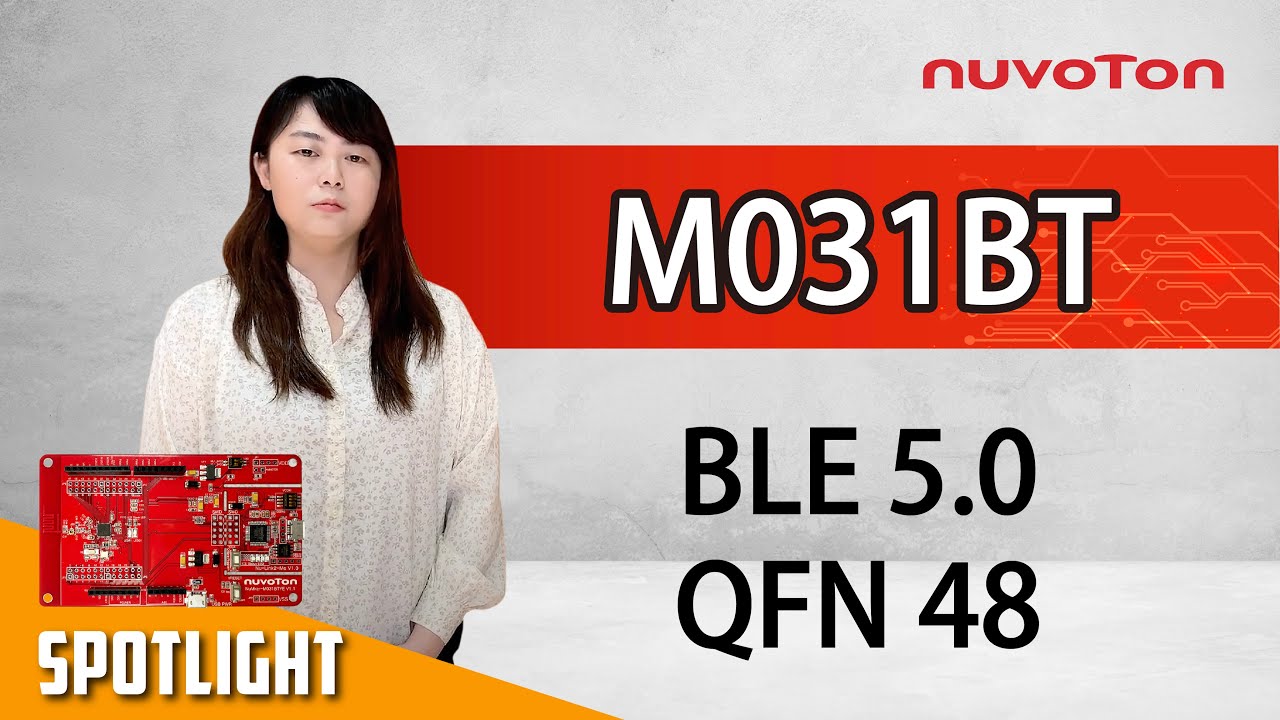
NuMicro® M031BT BLE 5.0 低功耗藍牙微控制器系列,以 Arm® Cortex®-M0 為核心,工作頻率高達 48 MHz,內建最高 128 KB Flash 和 16 KB SRAM,提供 BLE 5.0 和 2.4 GHz 雙模功能。相較於傳統集成簡單周邊的 BLE SoC,NuMicro® M031BT 系列內建豐富周邊與優異類比控制功能,實現一顆微控制器取代 BLE SoC 加控制晶片的方案,不僅大幅縮小 PCB 尺寸,QFN48封裝面積僅有 5mm x 5mm,也降低射頻佈局困難度,加上新唐參考設計方案與範例代碼,使得低功耗藍芽的應用開發變得相當容易。
NuMicro® M031BT 系列針對射頻應用提供高達 +8 dBm 的射頻發射功率、-94 dBm 的良好接收靈敏度、1 Mb/s 或 2 Mb/s 的傳輸速度,並且能在 2.4GHz 干擾嚴重的環境提供突出的抗噪表現,提升通訊距離和可靠性,滿足智慧家庭、消費電子以及工業物聯網等應用場景的需求。
NuMicro® M031BT 系列運作於 1.8V 至 3.6 V 工作電壓,內建 32 位硬體乘法器/除法器、高達 5 通道 PDMA、16 通道 12 位2 MSPS 高採樣率的 ADC 可運行在 1.8V 低電壓,提供精確且快速地效能表現,12 路 96 MHz PWM 可快速響應和精準的控制外部裝置。此外,M031BT 亦提供了豐富的周邊,例如 1 組 24 MHz SPI/I2S、3 組 6 MHz UART 並可支援單線式傳輸、2 組 I2C、1 組高彈性通用串行控制接口 (USCI) 可設為 UART, I2C 或 SPI。
NuMicro® M031BT 系列為了保護開發者的智慧財產權,內嵌一個額外的安全保護 Flash 區塊 (SPROM, Security Protection ROM),提供一個獨立且安全加密執行區域以保護關鍵程式代碼。記憶體鎖定功能 (Flash lock bits) 設計提供韌體防止外界存取或寫入保護。每一顆M031BT 具有一個 96 位元晶片唯一序號 (Unique Identification, UID) 及一個 128 位元唯一客戶序號 (Unique Customer Identification, UCID),大幅提升產品的保密與代碼安全性。
NuMicro® M031BT series: An low-power BLE 5.0 and 2.4GHz dual-mode microcontroller series by Arm® Cortex®-M0 core operating up to 48 MHz, with up to 128 KB Flash and 16 KB SRAM. In addition to the BLE 5.0 and 2.4GHz RF functions, the NuMicro® M031BT series built-in rich peripherals and analog control functions realize wireless connectivity. The 5mm x 5mm QFN48 package greatly reduces the PCB size and reduces RF layout difficulty. Furthermore, Nuvoton's reference design and rich sample code make the application development for low-power microcontroller with BLE/2.4G RF easier.
The NuMicro® M031BT series provides up to +8 dBm RF transmit power, a good receiving sensitivity of -94 dBm, 1 Mb/s, or 2 Mb/s transmission speed RF applications, and outstanding anti-noise performance in 2.4GHz interference environments to ensure communication distance and reliability. With these, the M031BT series are expected to meet the needs of application scenarios such as industrial Internet of Things (IIoT), smart home, consumer electronics, etc.
The NuMicro® M031BT series operates from 1.8V to 3.6V. It features a built-in 32-bit hardware divider, up to 5-channel PDMA, a 16-channel 12-bit 2 MSPS high sampling rate ADC that can run down to 1.8V low voltage, and 12-channel PWM running up to 96 MHz that can quickly respond and accurately control external devices. Besides, the M031BT also provides many peripherals such as one set of 24 MHz SPI/I2S, three sets of 6 MHz UART supporting single-wire transmission, two sets of I2C, and one set of highly flexible universal serial control interface (USCI) that can be configured as UART, I2C or SPI.
To protect the intellectual property rights, the NuMicro® M031BT series is embedded with an additional security protection Flash block (Security Protection ROM, SPROM) to provide an independent and secure encrypted execution area to protect critical program code. Flash lock bits are designed to provide firmware to prevent external access or write protection. There is a 96-bit unique chip identification (Unique Identification, UID) and a 128-bit unique customer identification (UCID) on each M031BT, which significantly improves product confidentiality and code security.
Nuvoton provides complete development tools, such as the NuMaker-M031BT evaluation board, software development kits, and sample codes, as well as free downloadable Keil MDK to speed up the end-product evaluation and development cycle.
-
更多產品資訊,請至新唐科技網站 https://bit.ly/3hVdcmC
購買管道:https://direct.nuvoton.com/tw
聯絡我們:SalesSupport@nuvoton.com

培訓
工具
學習
影片長度 - 2:10
Explain how to use Nu-Link2-Pro to program the target chip, make the target chip output the "Hello World" string via UART, and send it to the PC through the built-in virtual serial port interface of Nu-Link2-Pro and display it on the terminal software.
-
For more information, please visit Nuvoton Technology Website: https://bit.ly/3hVdcmC
Buy now: https://bit.ly/3bk0AD8
Contact us: SalesSupport@nuvoton.com
#en #Tool #Training #Intermediate #Learning

培訓
工具
學習
影片長度 - 4:36
1. Show how Nu-Link2-Pro can use ICP Programming Tool on PC to program target chips online
2. Show how Nu-Link2-Pro drag and drop files to the NuMicro MCU drive to program the target chip online
-
For more information, please visit Nuvoton Technology Website: https://bit.ly/3hVdcmC
Buy now: https://bit.ly/3bk0AD8
Contact us: SalesSupport@nuvoton.com
#en #Tool #Training #Intermediate #Learning

培訓
工具
學習
影片長度 - 4:14
The video will introduce you the NuMicro™ Family M251/M252 Series BSP, includes how to download the BSP and introduction of each sample codes and folders. And help you use the template to develop your first M251/M252 program.
#Tool #Training #Learning #Intermediate #en
-
For more information, please visit Nuvoton Technology Website: https://bit.ly/3hVdcmC
Buy now: https://direct.nuvoton.com/numaker-m251sd
Contact us: SalesSupport@nuvoton.com

網路研討會
影片長度 - 18:51
This video will introduce ARM TrustZone technology and show the example of how to program TrustZone on M2351. There is also a FIDO USB stick application demo in the end.
-
For more information, please visit Nuvoton Technology Website: https://bit.ly/3hVdcmC
Buy now: https://direct.nuvoton.com/en/m2351-series/
Contact us: SalesSupport@nuvoton.comon.com

創新產品
學習
影片長度 - 2:43
Hello! Everyone! I am Nuvoton FAE Tim.
Today, I will show you ML56 Capacitive Touch Key Technology.
First introduce the Capacitive Touch Key Fundamentals.
The capacitance of the sensor without a finger touch is called as “parasitic capacitance”, CP.
Parasitic capacitance results from the electric field between the sensor (including the sensor pad and traces) and other conductors in the system such as the ground planes, traces, any metal in the product’s chassis or enclosure, etc.
The capacitance between the sensor pad and the finger is CF.
The total capacitance CT of the sensor is the sum of CP and CF.
Next, we will explain the ML56 Capacitive Touch Key Sensing Method.
ML56 implements two switching capacitor banks for injecting charges to CP (or CT) and CR.
CR is the parasitic capacitance of reference channel.
After touch key calibration, CP and CR are balanced with CB and CCB (comparator output is “low”).
Touch the sensing touch key which makes CT = CP + CF Now the negative input terminal voltage of the comparator is lower than positive side and comparator output is “high”.
ML56 touch key controller will increase CCB to CCB’ to balance CT and CR again (comparator output is “low”). A finger touch can be detected by checking the difference of CCB and CCB’.
By comparing the CCB’ shift level from CCB, the steady state to a predetermined threshold, the algorithm can determine whether the touch key is in ON (Touch) or OFF (No Touch) state.
That's all for today's video, thank you everyone!
If you have any questions, please contact us.
-
For more information, please visit Nuvoton Technology Website: https://bit.ly/3hVdcmC
Buy now: https://direct.nuvoton.com
Contact us: SalesSupport@nuvoton.comon.com
#Product #Learning #Basic #en

培訓
工具
學習
影片長度 - 3:24
Hello everyone I am Chris, the Field Application Engineer from Nuvoton Technology.
Today I will introduce the programming and debugging tool, called NuLink-Gang, and NuLink2-Pro. And I will show you in what kind of situation you can utilize the tools.
During system development, Nuvoton provides three IDE interfaces: KEIL, IAR, and NuEclipse for user to develop source code.
When programming the Chip, Nuvoton provides ICP programming Tool in PC and the debugger Nu-Link2-Pro for users to perform debugging and programming function.
User who uses all of the Nuvoton Nu-Maker boards series can develop through the Nu-Link2-Me debugger and programmer; it’s attached to the board.
During the mass-production stage, there are 2 modes for programming the target chip. One is online programming and the other is offline programming.
At first, in online programming mode, user can use ICP programming Tool and a Nu-Link2-Pro to program a target chip. Besides, if it needs to program several chips at one times, the Nu-Link Command Tool supports program multiple develop board by several Nu-Link2-Pro.
Nu-Link2-Pro also supports drag-and-drop Flash programming. User can intuitively complete the programming action.
Nu-Link2-Pro
In offline programming mode, user can pre-store the programming file in SPI flash, USB flash drive, or SD card. When user wants to program the target chip, pressing the programming button on Nu-Link2-Pro to complete the programming action.
If it needs a large number of ICs to be programming, it recommends using the Nu-Link-Gang programmer. Nu-Link-Gang programmer can perform offline programming on four different chips at a time, significantly increasing the programming efficiency. Besides, Nu-Link-Gang programmer can also use the control bus to connect with an automatic programming machine for automatic programming.
In the system upgrade, Nu-Link2-Pro also provides five standard communication interfaces such as SPI, I2C, UART, RS485, and CAN for transmission, which is convenient for users to upgrade the system.
That’s all for the introduction of Nuvoton’s programming and debugging tool, NuLink-Gang, and NuLink2-Pro. Thank you for watching it. If you want to know more details, please contact us! Thank you.
#Tool #Training #Learning #Intermediate #en
-
For more information, please visit Nuvoton Technology Website: https://bit.ly/3hVdcmC
Buy now: https://direct.nuvoton.com/numaker-m251sd
Contact us: SalesSupport@nuvoton.com

培訓
工具
學習
影片長度 - 2:21
Hello everyone! I am Chris, the Field Application Engineer from Nuvoton Technology.
Today, I will introduce how to run a simple sample code on NuMicro M251/M252 series microcontroller.
First, we connect the M251/M252 NuMaker development Board to the computer.
Then click the M251/M252 BSP folder, click the Sample Code folder, template folder, Keil folder, and finally open the Template project file.
What we are going to do is running a simple GPIO Toggle LED Sample Code.
Introduce the main program briefly.
First, set GPIO PB14 to Output Mode.
After writing a small loop, set PB14 to reverse.
Finally, set CLK_SysTickDelay to 300,000 microseconds (uSec).
Before Rebuild, we must add the GPIO Source Code to the Library, find the corresponding Source Code and load it, and press Rebuild after it is complete. After the Rebuild, press Load and program the Code into the IC.
When programing is over, press the reset button on the development board to confirm whether the LED lights are flashing on the board.
That’s all for the tutorial of running sample code. Thank you for watching it. If you want to know more information, please feel free to contact us.
#Tool #Training #Learning #Intermediate #en
-
For more information, please visit Nuvoton Technology Website: https://bit.ly/3hVdcmC
Buy now: https://direct.nuvoton.com/numaker-m251sd
Contact us: SalesSupport@nuvoton.com

培訓
工具
學習
影片長度 - 5:53
Hello everyone, I am Morgan, the principal engineer of Nuvoton Technology. Today, I will show you how to connect to AWS IoT service using MbedOS on NuMaker-IoT-M487 development board
The sample code is on GitHub, the URL is https://github.com/OpenNuvoton/Mbed-to-AWS-IoT
To avoid typos, use keyword “OpenNuvoton” to search on google.
Find the Nuvoton on GitHub, and click it
On the Nuvoton GitHub page, use AWS as keyword to search the sample code: Mbed-to-AWS-IoT
Right click to copy the URL for later use.
Then enter the URL https://ide.mbed.com
After log in, make sure the NuMaker-IoT-M487 board has selected in the upper right corner. If not, please refer Nuvoton IoT Tutorial series “Get Started with Mbed OS”. There is detailed description of how to add a board.
Click the “Import” on the left of menu bar.
In the “Import Wizard”, click “Click here”
Please paste or key in the sample code URL to “Source URL:”,
Select Import as “Program”
Click “Import Name”, the project name “Mbed-to-AWS-IoT” will be filled automatically.
Then click “Import”.
After sample code imported, click “mbed_app.json” to open it.
To use Wi-Fi, you have to configure SSID and password to match your Wi-Fi AP setting.
In NuMaker_IOT_M487 session of mbed_app.json file, find the “wifi-ssid” to set your SSID. It is at line 44.
And then set password to “wifi-password”. It is at line 45.
Save it and click “Compile” to build the code.
It takes time to compile code, please wait.
You need an AWS account to use AWS IoT Core service. To create a thing, a policy, and certificates, then put the certificate to MQTT_server_setting.h file in the sample code. The sample code has included a certificate provided by Nuvoton for test only, so that you can quickly operate this example. If you don’t have an AWS account, it is recommended that you apply for an account and use your certificates in the example to observe the connection status on AWS IoT console page.
After completed, “Success” will appear in the compile output window.
The browser downloads the binary firmware file directly after a successful compiling. It will be saved in a default download folder. In Chrome, you can click download file and select “Show in folder”.
Then we connect the NuMaker-IoT-M487 USB port to your computer.
Please find the virtual COM port assigned for NuMaker-IoT-M487 in Device Manager. In the tutorial, the “Nu-Link Virtual Com Port” is COMx.
Then use your favorite terminal tool. Here we use Putty. Open the COMx port with 115200 baud rate.
And no flow control settings. Then “Open” it.
Back to the folder you just download the binary firmware file (Mbed-to-AWS-IoT.NUMAKER_IOT_M487.bin). Drag and drop the file to NuMicro MCU drive.
You will see the copying progress dialog box.
You can see the messages on terminal.
The device has acquired IP address from Wi-Fi AP, then successfully connect to AWS IoT and subscribe a topic.
Then press button (SW2) on board to send a message.
You can see the message published to server and received a message from server.
That’s all for this tutorial. Thank you for watching.
Welcome to subscribe to our channel.
If you want to get more information, please contact us “SalesSupport@nuvoton.com”
-
For more information, please visit Nuvoton Technology Website: https://bit.ly/3hVdcmC
Buy now: https://direct.nuvoton.com/en/numaker-iot-m487
Contact us: SalesSupport@nuvoton.com
#tool #training #learning #intermediate #en
培訓
工具
學習
影片長度 - 5:0
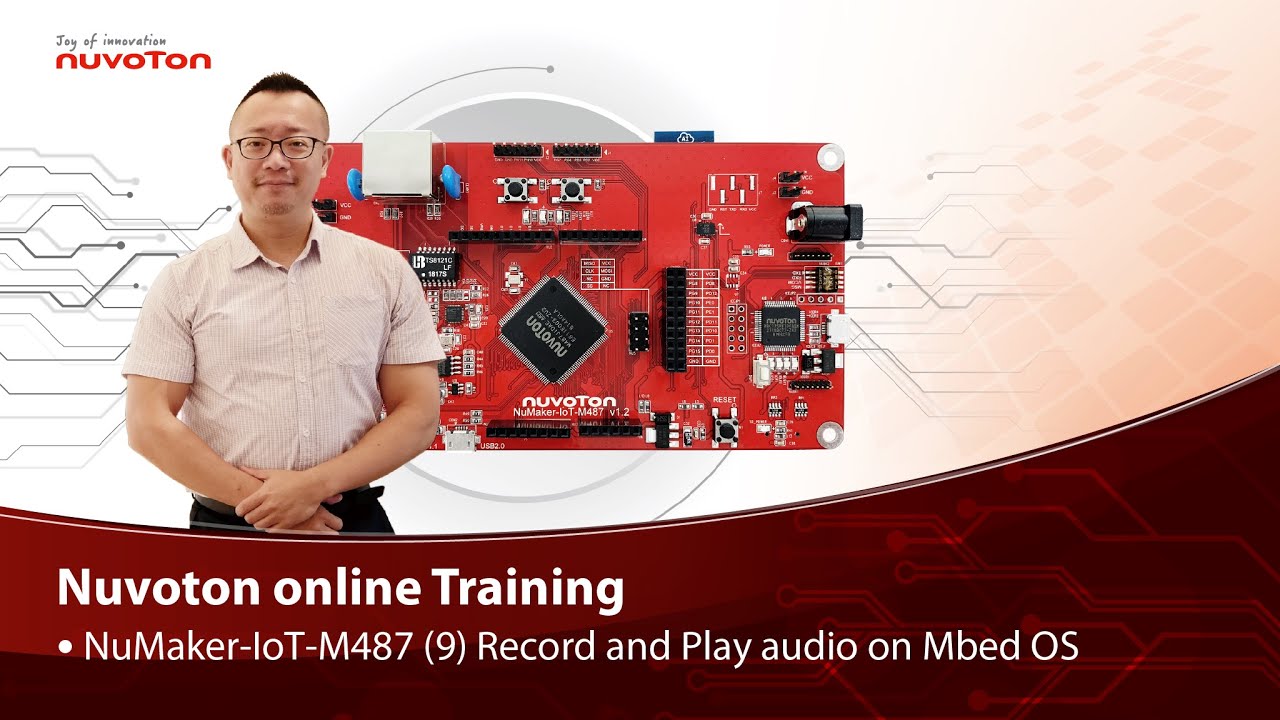
Hello everyone, I am Morgan, the principal engineer of Nuvoton Technology. Today, I will show you how to record and play audio with Mbed OS on NuMaker-IoT-M487 development board.
Open Chrome browser, and enter the URL https://ide.mbed.com to use the Mbed Online Compiler.
After log in, make sure that NuMaker-IoT-M487 board already selected in the upper right corner. If not, please refer Nuvoton IoT Tutorial series “Get Started with Mbed OS” which has a detailed description of how to add a board.
Click the “New” on the left of menu bar, a “Create new program” window will be displayed.
You can see that the Platform has been set to NuMaker-IoT-M487. In the Template, select the "NuMaker audio playback" for this tutorial. Then click OK.
Now you can see that the sample code has loaded on the page.
The sample code has three functions:
1. Record 10 seconds sound and save to Micro SD card
2. Play sounds stored in Micro SD card
3. Loopback. Record sound and play it immediately.
Click main.cpp to open it. Then scroll down to line 421. You can see the functions calls here. It set to loopback only.
Let’s do a little modification. Hit a key on console to start record 10 seconds then play it, and then do loopback.
printf("Press a key to start recording 10 seconds...");
getchar();
demo_record();
demo_play();
demo_loopback();
Save it and click “Compile” to build the code.
Compilation takes a while, please wait.
After the compilation is completed, “Success” will appear in the compile output window.
The browser downloads the binary firmware file directly after a successful compiling. It will be saved in a default download folder. In Chrome, you can click download file and select “Show in folder”.
Please plug an earphone commonly used for mobile phone in headphone jack on NuMaker-IoT-M487 board. For demonstration, we use a headphone splitter cable to connect a microphone and a speaker. Do not put the microphone and speaker too close to avoid feedback howling. Then connect the USB port to your computer and make sure the onboard LED lights up.
Back to the folder you just download the binary firmware file (NuMaker-mbed-AudioPlayback-example.NUMAKER_IOT_M487.bin). Drag and drop the file to NuMicro MCU drive.
You will see the copying progress dialog box.
Please find the virtual COM port assigned for NuMaker-IoT-M487 in Device Manager. In the demonstration, the “Nu-Link Virtual Com Port” is COMx.
Then use your favorite terminal tool. Here we use Putty. Open the COMx port with 9600 baud rate.
And no flow control settings. Then “Open” it.
Press “Reset” on board to run the firmware again.
Press a key on terminal to start record.
Speak for about 10 seconds, then your voice will be played.
That’s all for this tutorial. Thank you for watching.
Welcome to subscribe to our channel.
If you want to get more information, please contact us “SalesSupport@nuvoton.com”
-
For more information, please visit Nuvoton Technology Website: https://bit.ly/3hVdcmC
Buy now: https://direct.nuvoton.com/en/numaker-iot-m487
Contact us: SalesSupport@nuvoton.com
#tool #training #learning #intermediate #en

培訓
工具
學習
影片長度 - 3:55
Hello everyone, I am Morgan, the principal engineer of Nuvoton Technology. Today, I will show you how to use SD card with Mbed OS on NuMaker-IoT-M487 development board.
Open Chrome browser, and enter the URL https://ide.mbed.com to use the Mbed Online Compiler.
After log in, make sure that NuMaker-IoT-M487 board already selected in the upper right corner. If not, please refer Nuvoton IoT Tutorial series “Get Started with Mbed OS” which has a detailed description of how to add a board.
Click the “New” on the left of menu bar, a “Create new program” window will be displayed.
You can see that the Platform has been set to NuMaker-IoT-M487. In the Template, select the "NuMaker SD-File-System with SD mode" for this tutorial. Then click OK.
Now you can see that the sample code has loaded on the page. LittleFS uses less memory, supports power failure protection. However, LittleFS is different from the FAT file system, so after uses littleFS, the SD card will be formatted as LittleFS. The sample code uses FAT file system as default.
Just click “Compiler” to build the example.
It is in compiling, please wait a moment.
After the compilation is complete, “Success” will appear in the compile output window.
The browser downloads the binary firmware file directly after a successful compiling. It will be saved in a default download folder or the folder based on your browser setting. In Chrome, you can click download file and select “Show in folder”.
Please insert a micro SD card into the card slot on the back of NuMaker-IoT-M487 board, then connect the USB to your computer and make sure the onboard LED lights up.
Let’s back to the folder you just download the binary firmware file (NuMaker-mbed-SD-FileSystem-example.NUMAKER_IOT_M487.bin). Drag and drop the file to NuMicro MCU drive.
You will see the copying progress dialog box.
Please find the virtual COM port assigned for NuMaker-IoT-M487 in Device Manager. In the demonstration, the “Nu-Link Virtual Com Port” is COMx.
Then use your favorite terminal tool. Here we use Putty. Open the COMx port with 115200 baud rate
And no flow control settings. Then “Open” it.
Press “Reset” on board to run the firmware again.
You can see the messages on terminal while accessing SD card.
That’s all for this tutorial. Thank you for watching.
Welcome to subscribe to our channel.
If you want to get more information, please contact us “SalesSupport@nuvoton.com”
-
For more information, please visit Nuvoton Technology Website: https://bit.ly/3hVdcmC
Buy now: https://direct.nuvoton.com/en/numaker-iot-m487
Contact us: SalesSupport@nuvoton.com
#tool #training #learning #intermediate #en

前瞻應用
學習
影片長度 - 3:9
以新唐 NuMaker-IoT-M263A 為平台,使用 Mbed OS 進行開發,學習各種功能。觀看本片,您將學會使用 NuMaker-IoT-M263A 開發板配合 Mbed OS 範例程式控制環境感測器,顯示溫度、溼度和氣壓等數據。
哈囉大家好,我是新唐工程師 Miya。今天為大家介紹,如何使用新唐 NuMaker IoT-M263A 在 MbedOS 使用環境感測器,它是參考 Mbed 社群 提供的環境感測器的控制範例,很快速就能整合完成實際應用。
首先打開 Chrome 瀏覽器,輸入網址 "https://ide.mbed.com/",登入後先確認右上方板子已經有帶出 "NuMaker-IoT-M263A 及板子小圖示" 了,如果沒有可參考教學影片 "step by step 讓你了解如何運行 Mbed OS",裡面有詳細的示範怎麼新增板子的方法。
首先點選左上方的 "New",會載入一個 Create new program 的小視窗,上面可以看到 Platform 已經帶出 NuMaker-IoT-M263A,在 Template: 這欄選取 sample code,使用 NuMaker Env. Sensor BME680 example,點一下 OK。
現在可以看到 sample code 已經載入頁面,這份 sample code 已經內建好使用 Sensor 的設定,可直接按 Compile 執行編譯程式碼。編譯中需要等待一下,編譯完成後下方會出現 "success!"。
系統會把編譯完成的 bin 檔,放在 download 資料夾,直接從下方進入,上拉後點一下 "Show in folder" 到預設的 download 夾,接著把 NuMaker-IoT-M263A 板子跟 PC 接上 USB,確認板子有亮燈就是通電了。
回到 download 資料夾,可以看到多了一個剛才 compile 完成的 bin 檔,按右鍵傳送到 NuMicro MCU(F:),這邊分配到哪一槽要看各位的電腦決定,有成功點選到的話會出現傳送過去的畫面。
到電腦的裝置管理員,查看分配到的 port 編號,在本機按右鍵點裝置管理員,找到連接埠 (COM和LPT),找到 USB 序列裝置,就可以知道像這部 PC 分配給它的是 COM12。
接下來使用終端機模擬軟體,各位可以用自己熟悉的軟體操作即可。設定 Serial line 為 COM12,Speed 為 115200,到 Serial 將 Flow control 改為 None,接著 OPEN。接著在終端機摸擬軟體就可以看到目前的環境感測數值回報等資料。
以上是這次的教學影片,感謝您的收看,如果您想知道更多資訊,歡迎聯絡我們。
-
更多產品資訊,請至新唐科技網站 http://www.nuvoton.com
購買管道:https://direct.nuvoton.com/tw/numaker-iot-m263a
聯絡我們: SalesSupport@nuvoton.com
#application #learning #intermediate #zh-Hant
 粤公网安备 44030502010001号