


M55M1R2LJAE
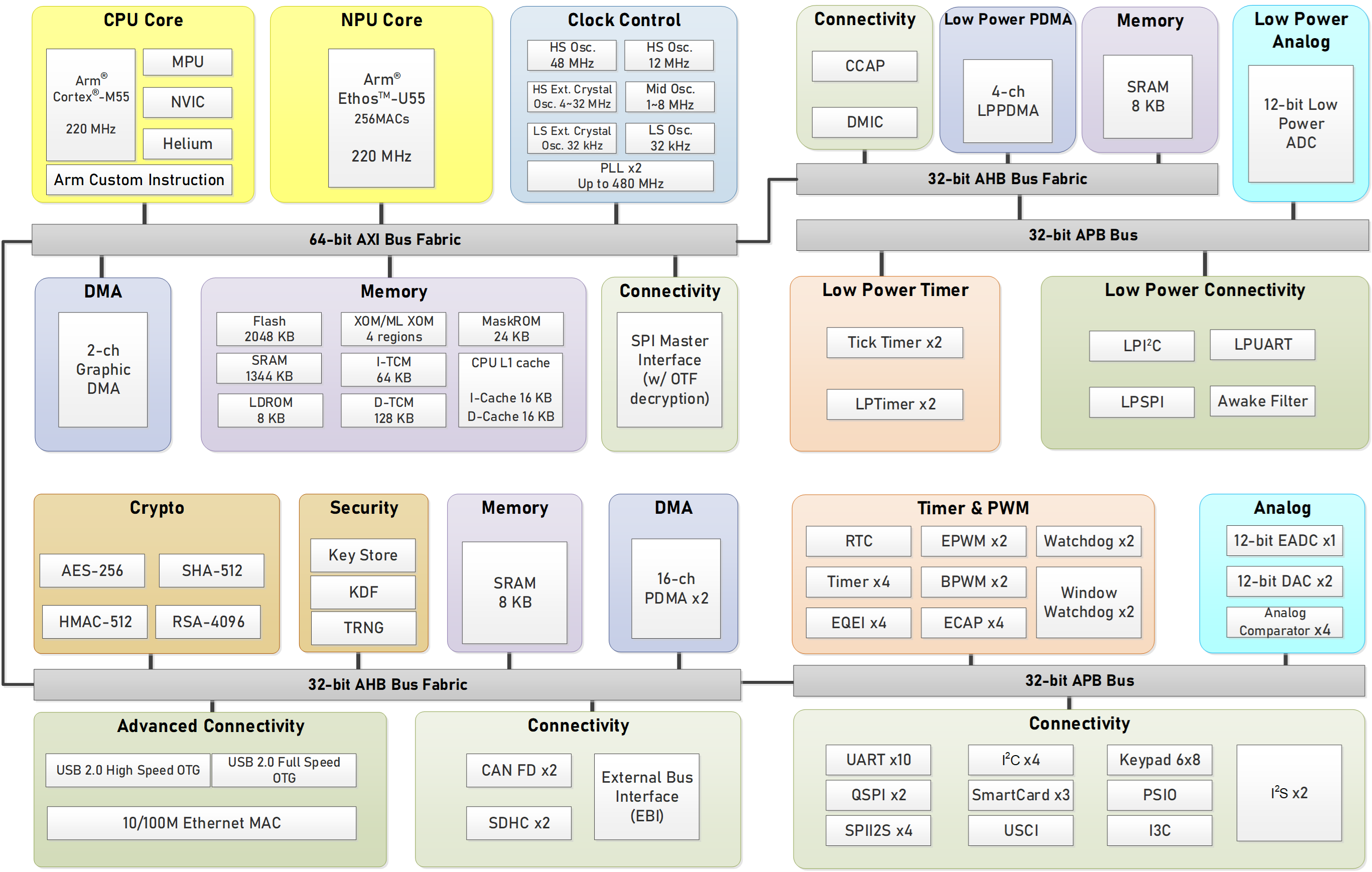
NuMicro® M55M1R2LJAE 是一款新世代 AI 微控制器,提供高达 110 GOPS 的 AI 运算性能,专为 终端 AI (Endpoint AI) 应用设计,例如数据识别与智能音频。
M55M1R2LJAE 采用 220 MHz Arm® Cortex®-M55 32 位核心,并集成 Arm® Ethos™-U55 神经处理单元 (NPU) 作为协同处理器,加速神经网络运算。除了卓越的 AI 性能外,M55M1R2LJAE 还具备 DSP 扩展、Helium 向量扩展、双精度浮点运算单元 (FPU)、两组 16 通道 PDMA 控制器以及一组 2 通道 GDMA 控制器,非常适合需要高强度运算的嵌入式应用,例如 音频处理、通信、数字信号处理、机器学习与传感器融合。
灵活的存储与扩展选项
M55M1R2LJAE 内建 最高 1.5 MB RAM 与 2 MB Flash,并支持 OctoSPI 与 HyperBus 接口,可扩展外部 RAM 与 Flash 容量。其支持 1.71V 至 3.6V 的供电电压范围,工作温度涵盖 -40°C 至 +105°C。
节能設計與強大安全性
在功耗与安全方面,M55M1R2LJAE 提供五种低功耗模式,并支持多种可在低功耗模式下仍能运行的外设,包括 CCAP、DMIC、I²C、SPI、Timer、UART、ADC 与 GPIO。
此外,M55M1R2LJAE 内建多层次安全机制,包括:安全启动 (Secure Boot)、TrustZone、真随机数发生器 (TRNG)、密钥存储、硬件加密加速器、篡改检测(Tamper Detection) 以及符合 PSA Certified™ Level 2 规范,为 IoT 与嵌入式应用提供可靠防护。
灵活的 IDE 兼容性与调试工具
Nuvoton 提供 NuMaker-X-M55M1D 评估板 与 Nu-Link 调试工具。此外,M55M1R2LJAE 支持常用的开发环境,包括 Keil MDK、IAR EWARM、以及搭配 GNU GCC 的 Eclipse IDE。
M55M1R2LJAE 适用于多种应用市场,包括:
- 人体感测
- 机器人
- 智能玩具
- 传感器中枢 (Sensor Hub)
- 智能家电
- 个人电脑周边
- AIoT (人工智能物联网)
关键特性:
操作特性 (Operating Characteristics)
- 电压范围:1.71V ~ 3.6V
- 温度范围:-40°C ~ +105°C
- ESD HBM:±3 kV
- EFT:±4.4 kV
- Latch Up:±200 mA
核心 (Core)
- Arm Cortex-M55 核心,最高运行频率 220 MHz
- 支持 Arm M-profile 向量扩展 (Helium)
- 符合 IEEE 754 的浮点运算单元 (FPU),可进行向量与纯量的半精度、单精度与双精度浮点运算
- Arm TrustZone 技术,内含 8 区安全内存保护单元与 8 区非安全内存保护单元
- Arm 自定义指令 (ACI),加速特定数学运算
- L1 快取:16 KB 指令快取 (I-cache) 与 16 KB 资料快取 (D-cache)
微型神经处理单元 (Micro-NPU)
- Arm Ethos-U55 微型神经处理单元
- 运行频率高达 220 MHz
- 256 个 MACs (乘加运算单元)
- 110 GOPS (220 MHz x 256 MACs x2)
内存 (Memories)
- Secure Boot ROM (MaskROM):24 KB
- APROM Flash:2 MB(双组,每组 1 MB)
- LDROM Flash:8 KB
- OTP Flash:3 KB
- XOM (仅可执行内存):4 区
- SRAM0:512 KB
- SRAM1:512 KB
- SRAM2:320 KB
- SRAM3:8 KB
- LPSRAM:8 KB
- I-TCM:64 KB
- D-TCM:128 KB
外部内存接口
- SPIM(含 HyperBus 接口),支持 SPI Flash、QSPI、OSPI、HyperFlash,容量最高 32 MB,并具备 AES 实时解密功能
- 外部总线接口 (EBI),支持 8/16 位数据宽度、i80 LCD 接口,以及最多 3 组 1 MB 内存
时钟 (Clocks)
- 4~32 MHz 高速外部晶振
- 32.768 kHz 低速外部晶振
- 48 MHz 高速内部 RC 振荡器
- 12 MHz 高速内部 RC 振荡器(2% 偏差)
- 1~8 MHz 高速内部 RC 振荡器
- 32 kHz 低速内部 RC 振荡器
- 2 组可程序化 APLL,最高 480 MHz
DMA (直接内存访问)
- 2 组 16 通道 PDMA 控制器
- 1 组 2 通道 GDMA 控制器 (DMA-350)
- 1 组 4 通道 LPPDMA 控制器
安全功能 (Security Functions)
- 安全开机 (Secure Boot)
- 密钥衍生函数 (KDF)
- 加解密加速器,支持 AES-256、ECC-571、SHA-512、HMAC-512、RSA-4096,以及伪随机数产生器 (PRNG)
- 真随机数产生器 (TRNG)
- 密钥储存模块 (Key Store),含专用 SRAM 缓冲区
- 4 区 XOM 仅可执行内存,确保程序代码安全
- Flash 内存写入保护
电源管理 (Power Management)
- 动态功耗:94.5 μA/MHz(于 220 MHz 操作下)
- 正常待机模式 (NPD4),64 KB SRAM 保持:23.26 μA (3.0V下操作)
- 低功耗待机模式 (SPD1),64 KB SRAM 保持:6.1 μA (3.0V下操作)(可保持最高 64/128/192/256/320/384/448/512 KB SRAM)
- 深度待机模式(RTC 开启):0.74 μA (3.0V下操作)
- RTC(VBAT):0.51 μA
- 支援 Power-on reset (POR)
- 支援 Brown-out reset(BOR)
- 支援 Low voltage reset(LVR)
- 内建 LDO
定时器与控制外围
- 4 组 32 位 定时器,支持 PWM 功能
- 2 组 32 位 低功耗定时器,支持 PWM 功能
- 2 组 tick 定时器1 组 24 位 倒数 SysTick 定时器
- 2 组 看门狗定时器
- 2 组 窗口看门狗定时器
- 最多 12 路增强型 PWM (EPWM) 输出,带有 12 个 16 位定时器
- 最多 12 路基本型 PWM (BPWM) 输出,带有 2 个 16 位定时器
- 最多 4 组增强型正交编码器接口 (EQEI)
- 最多 4 组增强型输入捕捉单元 (ECAP)
通讯接口 (Connectivity Interfaces)
- 最多 10 组 UART
- 最多 1 组 LPUART
- 最多 4 组 I²C,最高 1 Mbps
- 最多 1 组 LPI²C,最高 1 Mbps
- 最多 1 组 I3C,最高 25 Mbps
- 最多 4 组 SPI/I²S
- 最多 1 组 LPSPI
- 最多 2 组 QSPI
- 最多 1 组 USCI(支援 UART/I²C/SPI)
- 最多 2 组 SDIO
- 最多 3 组 ISO-7816-3 智能卡界面
- 最多 2 组 I²S
- 最多 1 组 8 通道 PSIO
- DMIC(数字麦克风输入),支持 4 通道 PDM 接口与语音启动检测 (VAD)
- 6×8 按键矩阵 (KPI)
进阶通讯功能 (Advanced Connectivity)
- 最多 2 组 CAN FD
- USB 2.0 高速装置/主机/OTG 控制器(内建 DMA 与 PHY,支持 PD 功能)
- USB 2.0 全速装置/主机/OTG 控制器(内建 PHY,装置模式支持免晶振)
- 10/100 Ethernet MAC,支持 RMII 与 IEEE 1588 v2 精准时间协定
低功耗外围 (Low Power Peripherals)
- LPSRAM:8 KB
- 最多 1 组 LPUART
- 最多 1 组 LPI²C
- 最多 1 组 LPSPI
- 1 组 4 通道 LPPDMA
- 2 组低功耗定时器, 支持 PWM 功能
- 1 组 12 位,最高 24 通道,2 Msps SAR LPADC
影像撷取控制器 (CCAP)
- 分辨率最高 640×480
- 低功耗模式下支持 320×240 动态影像侦测
模拟外围 (Analog Peripherals)
- 1 组 12 位,最高 24 通道,5 Msps SAR ADC
- 1 组 12 位,最高 24 通道,2 Msps SAR LPADC
- 最多 2 组 12 位,1 Msps buffered DAC
- 最多 4 组模拟比较器 (ACMP)
- 内建参考电压源
- 内建温度传感器
CRC 循环冗余计算
实时时钟 (RTC)、防窜改与 VBAT 电源域
- 支持独立 VBAT 电源脚位,用于 RTC 与防窜改侦测
- 支持行事历型 RTC
- 备份缓存器:80 字节
- 防窜改侦测:6 个脚位
I/O 功能
- 最多支持 39 个具备中断功能的 GPIO
- GPIO 内建上拉 / 下拉电阻
96 位 唯一 ID (UID)
128 位 唯一客户 ID (UCID)
封装 (Package)
- 无卤素,符合 RoHS 与 TSCA 规范
| 脚位数 | 64 |
| 封装类型 | LQFP |
| I/O脚位数 | 39 |
| 引脚间距 | 0.5 |
| 封装尺寸(mm) | 10 x 10 |
 粤公网安备 44030502010001号