
Automotive-grade PMIC Application Analysis in BDU and PDU
With the rapid rise of electric vehicles (EVs) and continuous advancements in related technologies, EVs are quickly replacing traditional internal combustion engine vehicles as the preferred mode of transportation. In this trend, components related to safety, such as the Battery Disconnect Unit (BDU) and Power Distribution Unit (PDU), play a crucial role and are receiving significant attention. As the "heart" of high-voltage systems in electric vehicles, the PDU not only controls the charging and discharging rhythm but also ensures circuit safety, preventing overload and short-circuit risks. It is also responsible for key functions, such as high-voltage sampling and low-voltage control, ensuring the stable operation of electric vehicles.
As an essential component for battery status monitoring and protection, the BDU is specifically designed for battery packs and can be considered an alternative to a power distribution box. BDUs are typically customized according to the needs of automakers, making it important to gather customer requirements and electric vehicle electrical performance. Based on the installation position of the BDU within the battery pack, it can be classified into internal battery box installations and external battery junction boxes. In general, PDU and BDU functionalities may overlap, and different automakers may choose either a PDU or BDU depending on their design preferences. For simplicity, this analysis will focus on the PDU, which has a broader functional coverage.
According to industry data, the global PDU market is expected to grow at a compound annual growth rate (CAGR) of 22% over the next six years, reaching $6.71 billion by 2029. The Asia-Pacific region, as the largest market, holds about 70% of the market share. As China is the largest market for new energy passenger vehicles in the Asia-Pacific region, its contribution and influence on the PDU market are significant. With the trend of electrification in Chinese passenger vehicles and the increasing focus on integrated power batteries, high safety, and cost reduction, the demand for PDU components has undergone notable changes.
Looking at the recent development trends of PDUs, integration with other components, such as BMS (Battery Management System) or VCU (Vehicle Control Unit), modularization, and standardization are becoming prevalent. As the trend shifts toward 800V systems, the PDU and BDU have stricter requirements for voltage, current monitoring, electrical levels, and the complexity of electrical conditions.
Regardless of how PDU evolves, its core functions should remain consistent:
- Managing high-voltage distribution and providing centralized protection for the high-voltage electrical system.
- Accurate monitoring is essential for both management and protection.
Example PDU Product Specifications:
|
Parameter Name |
Min Value |
Max Value |
Unit |
Operating Conditions |
|
Input Voltage (High Voltage) |
0 |
900 |
VDC |
850V (Max altitude 5,000 meters) 900V (Max altitude 2,000 meters) |
|
Input Voltage (Low Voltage) |
10 |
32 |
VDC |
|
|
Reverse Polarity Protection |
Supported |
|||
|
Active/Passive Discharge |
350 |
500 |
A |
Supported |
|
Output Overcurrent Protection |
60C discharge current for 10 minutes |
|||
|
External Temperature |
-40 |
85 |
°C |
|
|
Battery Voltage Monitoring |
200 |
900 |
V |
Accuracy +/- 1% |
|
Temperature Monitoring |
-30 |
150 |
°C |
Accuracy +/- 5K |
|
Insulation Monitoring |
Supports Upstream/Downstream |
|||
|
High Voltage Interlock |
Supported |
|||
|
Configurable Battery Fuse |
||||
|
Short Circuit Protection |
||||
|
Circuit Breaker/Relay Control |
Via CAN |
|||
|
Pre-charge Support |
Supported |
|||
|
Collision Signal Monitoring |
Supported |
|||
|
Vibration Compliance |
ISO 16750-3 compliant |
|||
|
CAN Communication |
SAE J1939 compliant |
|||
|
Auxiliary Fuse |
Key Monitoring Requirements for PDU Control Board:
- Voltage Monitoring (Self-Test)
- Total Voltage Monitoring
- Current Monitoring
- Temperature Monitoring
- Insulation Monitoring
- High Voltage Interlock Monitoring
- Impact Monitoring
- Vibration Monitoring
- Communication Management
- Relay/Circuit Breaker/Fuse Overcurrent and Short Circuit Protection
- Compliance with Functional Safety ASIL-C or D
To meet the required ASIL functional safety levels, Nuvoton launched the KA84917UA PMIC in September 2023, specifically designed for battery pack monitoring. This chip works with Nuvoton’s BM-IC and COM-IC to form a typical system application as follows:
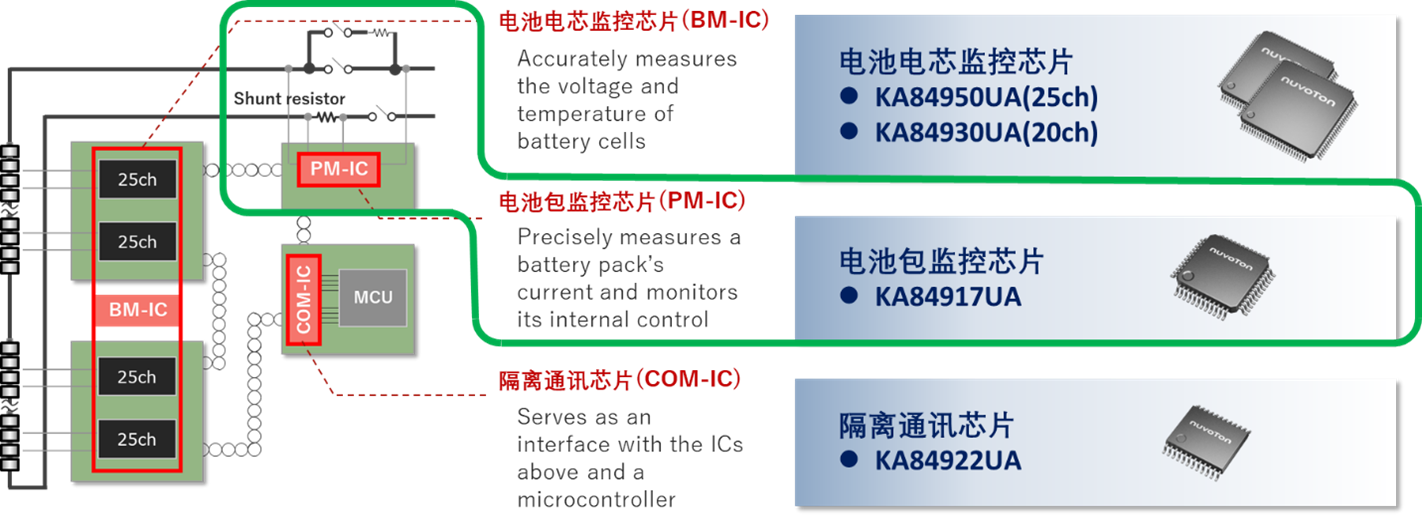
Key Features of KA84917UA:
- Supports battery pack total voltage, current, and insulation monitoring.
- High-precision current sensing (<0.3% accuracy), compatible with high-side and low-side current sensors.
- Built-in fully redundant measurement system for functional safety.
- Supports isolated bidirectional daisy-chain communication with up to 2.5Mbps speed.
- With Nuvoton’s KA84950/30 series battery management chips, it supports V-I synchronized measurement, providing the industry’s fastest 10 µs synchronization.
- Provides 12 GPIO channels for general output control, analog input, and ADC sampling.
- SPI Master interface supports connecting 2 SPI slave devices.
- I2C interface support.
- Complies with ISO-26262 safety standards, supporting up to ASIL-D functional safety.
- AEC-Q100 component certification.
- Package: 48-pin QFP.
The KA84917UA can directly measure total voltage, current, and insulation resistance. Other measurements, such as voltage (self-test), temperature, and high-voltage interlock monitoring, can be implemented using the 12 GPIO (ADC channels). Collision and vibration monitoring can be achieved through sensor-based or non-sensor methods, utilizing I2C, SPI, or GPIO protocols. The communication section supports SPI isolation, daisy-chain communication, and CAN (via MCU). Protection actions, including fuse activation, relay or circuit breaker control, can be implemented via GPIO or SPI drivers, depending on the application. For functional safety, KA84917UA utilizes SOI (Silicon On Insulator) technology for high-voltage isolation and features a fully redundant measurement system, ensuring compliance with ASIL-D requirements.

Conclusion
Nuvoton’s PMIC, the KA84917UA, is an ideal system monitoring chip for PDU and BDU applications. It significantly simplifies design, enhances product safety and stability, and accelerates time-to-market. Nuvoton continues to lead the way in battery management and analog components, offering a comprehensive product and technology roadmap. For further application discussions or product inquiries, please visit Nuvoton's official website (www.nuvoton.com) and contact Nuvoton's team.
 粤公网安备 44030502010001号