Object and Food Recognition Application Based on Nuvoton Endpoint AI MCU

Application Background

In the AI era, the importance of object recognition and image processing has grown. As a key branch of artificial intelligence, image recognition enables machines to simulate human visual perception, allowing them to understand, identify, and interpret images and videos.
This technology has been widely adopted in smart home appliances, object classification, industrial automation, machine vision, intelligent surveillance, and medical imaging diagnostics..

Arm Cortex-M55 and Ethos-U55 NPU

The Arm Cortex-M55 is a high-efficiency, low-cost microcontroller IP designed for image sensor data processing and general-purpose computing, ideal for edge AI inference and display applications.
The Arm Ethos-U55 NPU, designed specifically for neural network acceleration, pairs seamlessly with the M55. According to Arm, the Ethos-U55 is the world’s first micro NPU optimized for the Cortex-M architecture, making it suitable for resource-constrained eendpoint devices.

While AI inference is traditionally executed on GPUs, NPUs offer superior energy efficiency and computational performance due to their dedicated architecture. The Ethos-U55’s compact and low-power design enables AI inference on small form-factor devices, driving the proliferation of AI at the edge.

Advantages of Nuvoton M55M1 in Food Recognition Applications

Leveraging the YOLO object detection algorithm, Nuvoton’s M55M1 MCU can realize an intelligent food recognition system within smart refrigerators.

It can identify common fruits (e.g., apple, cherry, banana, strawberry), vegetables (e.g., carrot, spinach, potato), meats (e.g., beef, ham), dairy products (e.g., milk, cheese), and other daily ingredients (e.g., eggs).

The model is trained with high-quality image datasets, ensuring accuracy and robustness across diverse real-world scenarios.

Through deep learning, the M55M1 achieves real-time recognition and tracking of stored items, greatly enhancing food management efficiency and accuracy — enabling applications in smart appliances, dietary health management, and food waste reduction.

Commercial Application Scenarios

  • Core recognition for smart refrigerators
  • Smart shopping and auto-replenishment systems
  • Inventory monitoring for food delivery platforms
  • Intelligent stock management for restaurants
  • Driving smart upgrades in home appliances

Technical Features and Innovations

  • Multi-class, high-accuracy recognition
  • Real-time detection with YOLO architecture
  • Adaptive learning for new items and packaging
  • On-device processing for privacy protection

Medicine Classification Applications

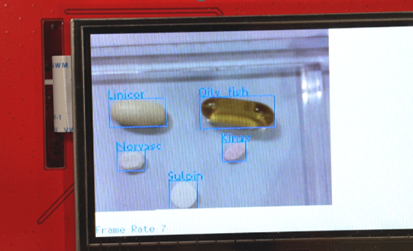
The M55M1 can also be applied to medicine classification and management systems, improving medication retrieval efficiency and safety using the same AI recognition framework.


medicine classifier


M55M1 MCU and Development Resources

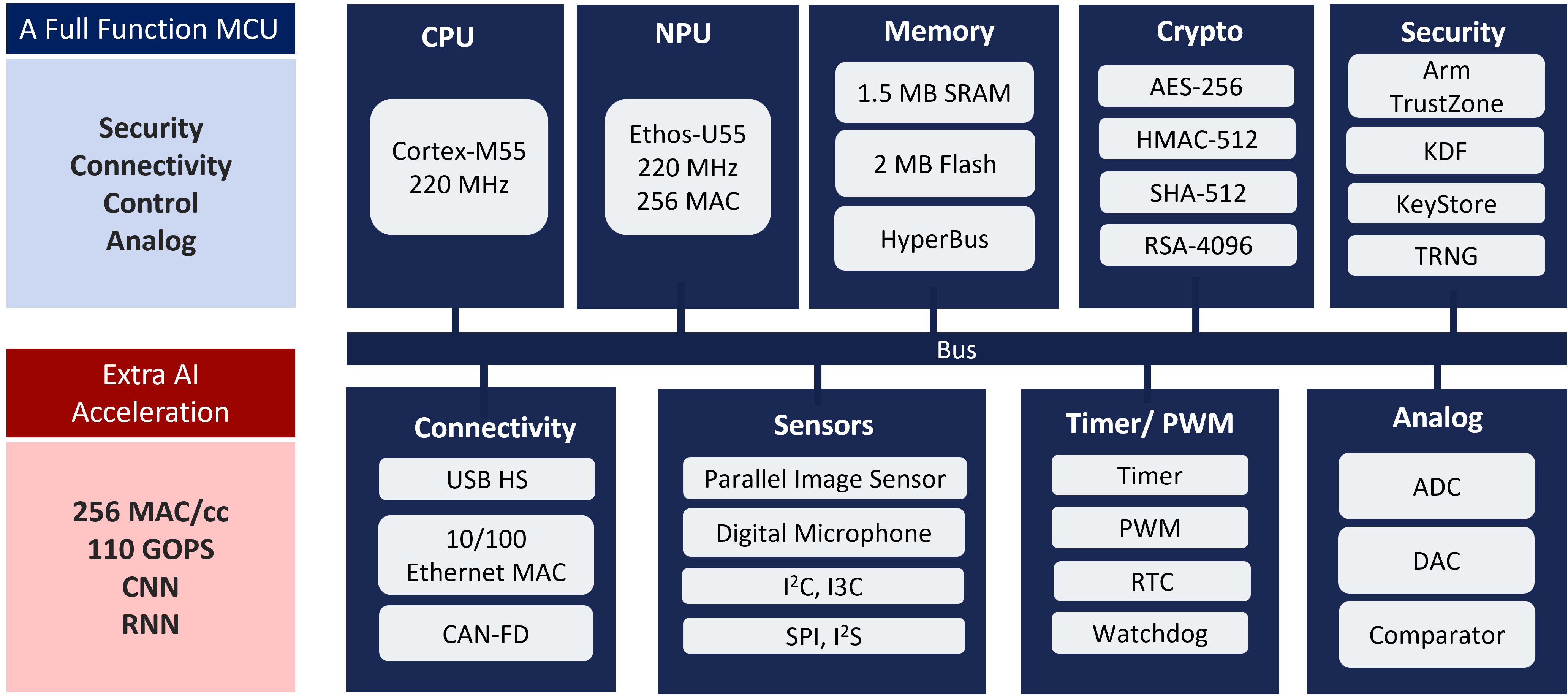
The M55M1 microcontroller integrates a 220 MHz Arm® Cortex®-M55 CPU and a 220 MHz Arm® Ethos™-U55 NPU, delivering enhanced AI performance for machine learning inference and CNN/RNN computation. It features 1.5 MB SRAM and 2 MB Flash Memory, and supports the HYPERBUS™ interface for HYPERRAM™ or HYPERFLASH™ expansion.


m55m1


Nuvoton’s NuEzAI-M55M1 development board, powered by the Arm® Cortex®-M55-based NuMicro® M55M1 MCU, pairs with an online model training tool that lets users train an image recognition model in 3 minutes — without requiring deep programming or AI expertise.

NuEzAI-M55M1 streamlines edge AI development, enabling even non-expert developers to quickly create and deploy models, making it an ideal evaluation platform to accelerate time-to-market.

NuML Toolkit

Optimized for the M55M1, the NuML Toolkit integrates Keil µVision®5 / Arm Compiler 6 (armc6), Make / GCC, and supports converting full-INT8 quantized AI models into Keil example code, simplifying AI deployment.
Developers can seamlessly integrate PC-trained models into MCU projects without worrying about model conversion formats, allowing them to focus on peripheral control programming.
The NuML Toolkit makes AI deployment more intuitive — ideal for developers aiming to integrate AI functions rapidly into embedded systems.