
Nuvoton MA35D1 Series Microprocessor for Vibration Monitoring Solutions
What is Vibration Monitoring?
- Definition: Vibration monitoring refers to the process of measuring, analyzing, and evaluating the vibration characteristics of equipment or structures. The goal is to understand their operating status and performance. Vibration monitoring can be categorized into:
- High-frequency vibration monitoring (e.g., motor vibration monitoring)
- Low-frequency vibration monitoring (e.g., bridge vibration monitoring)
- Purpose: The primary goal of vibration monitoring is to detect equipment failures in a timely manner, evaluate performance, predict potential risks, and take appropriate maintenance actions to ensure the safe, stable, and efficient operation of equipment.
Vibration Monitoring Applications:
- Mechanical Equipment Monitoring: High-temperature vibration sensors are used to monitor the operational status of machinery in real-time, enabling the early detection of potential failures and preventing equipment damage and downtime.
- Aerospace: In the aerospace industry, high-precision vibration sensors are used to monitor the vibrations of aircraft, rockets, and other flying vehicles, ensuring flight safety.
- Bridges and Buildings: Vibration sensors can be used to monitor the vibrations of bridges, buildings, and other structures, assessing structural safety and preventing potential safety hazards.
- Transportation: In the transportation industry (e.g., railways and highways), vibration sensors monitor the vibrations of vehicles, tracks, and other equipment, improving the safety and reliability of transportation systems.
Nuvoton MA35D1 Series Microprocessor:
The NuMicro® MA35D1 Series is a heterogeneous multi-core microprocessor featuring a heterogeneous architecture with two 64-bit Arm® Cortex®-A35 cores running at up to 800 MHz, and one 180 MHz Arm® Cortex®-M4 core. To simplify system design and production, the MA35D1 series offers both LQFP and BGA packaging options, featuring stacked DDR2/DDR3L SDRAM up to 512 MB, which significantly reduces PCB layers, footprint, and electromagnetic interference (EMI). The MA35D1 series also supports high-performance communication interfaces such as Gigabit Ethernet, SDIO 3.0, high-speed USB 2.0, CAN-FD, etc. Additionally, it includes an LCD display controller with a maximum resolution of 1920 x 1080 at 60 FPS, a graphics accelerator, and hardware decoding for JPEG and H.264, delivering enhanced graphical user interfaces (GUIs) and video playback.
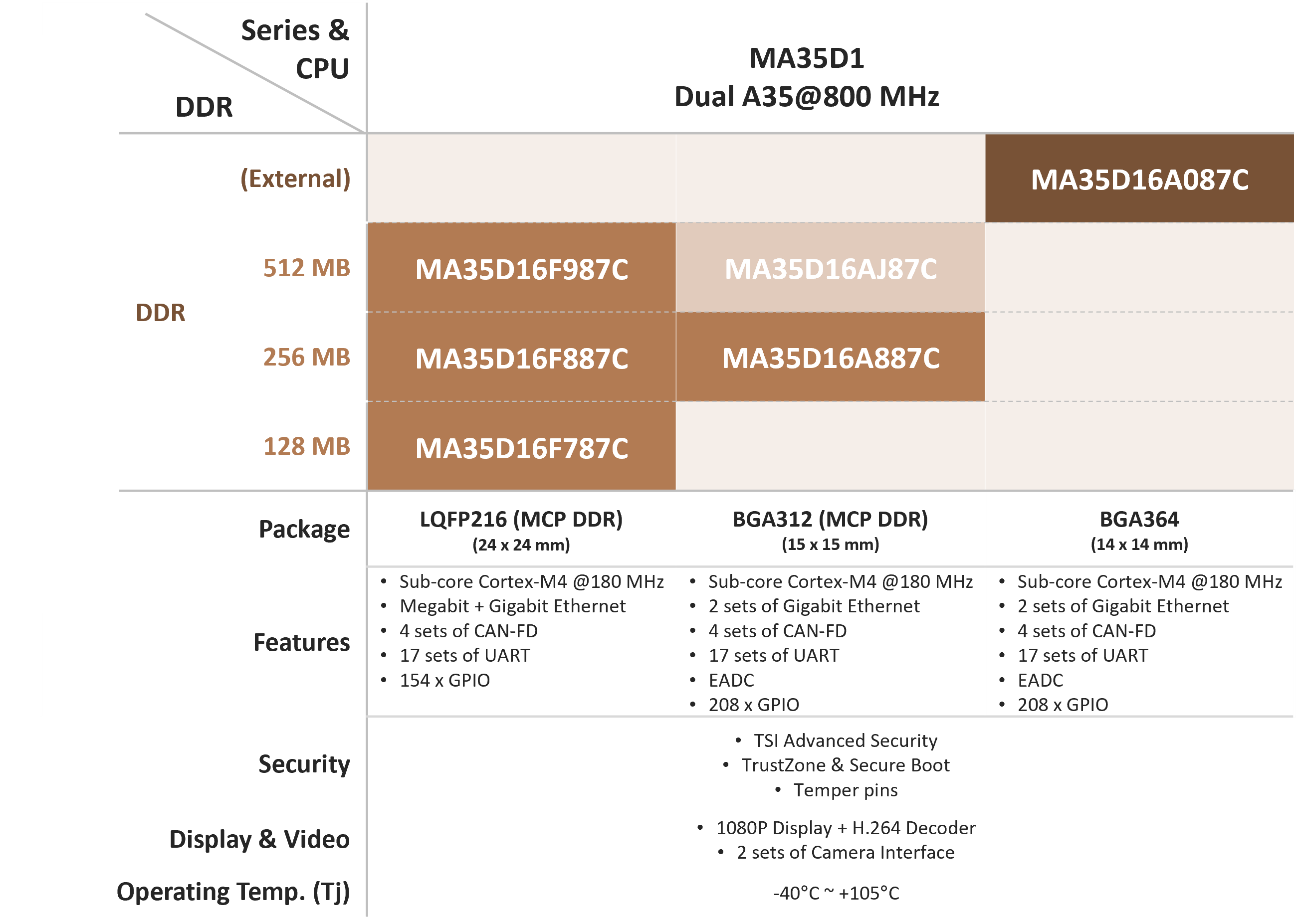
MA35D1 Series Product Selection Table
Advantages of the MA35D1 Series in Vibration Monitoring Applications:
- Large DDR Memory for Data Processing and Hardware Design:
The MA35D1 series comes with built-in DDR memory, with a maximum capacity of 512 MB, making it suitable for handling large-scale data processing. With LQFP and BGA packaging options, it provides flexibility for hardware design and application. - Integrated M4 Core to Meet Real-time Data Collection Requirements:
The M4 core of the MA35D1 efficiently handles real-time data collection tasks. It supports peripherals such as ADC, UART, SPI, and I2C, and can leverage the A35 core for other computational tasks, optimizing the overall system efficiency. - Supports LINUX and OpenWRT for Improved Ethernet and 4G Connectivity:
The A35 core supports LINUX and OpenWRT systems, simplifying program development and maintenance. With Ethernet, the complete TCP/IP protocol stack is supported, enhancing compatibility and stability. For 4G modules, the LINUX drivers provided by vendors simplify the development process. - Shared DDR Memory for High-Speed Data Transfer Between M4 and A35 Cores:
The M4 and A35 cores communicate through shared DDR memory, enabling rapid data transmission. This shared memory architecture enables near-microsecond-level data transfer, significantly enhancing data processing performance.
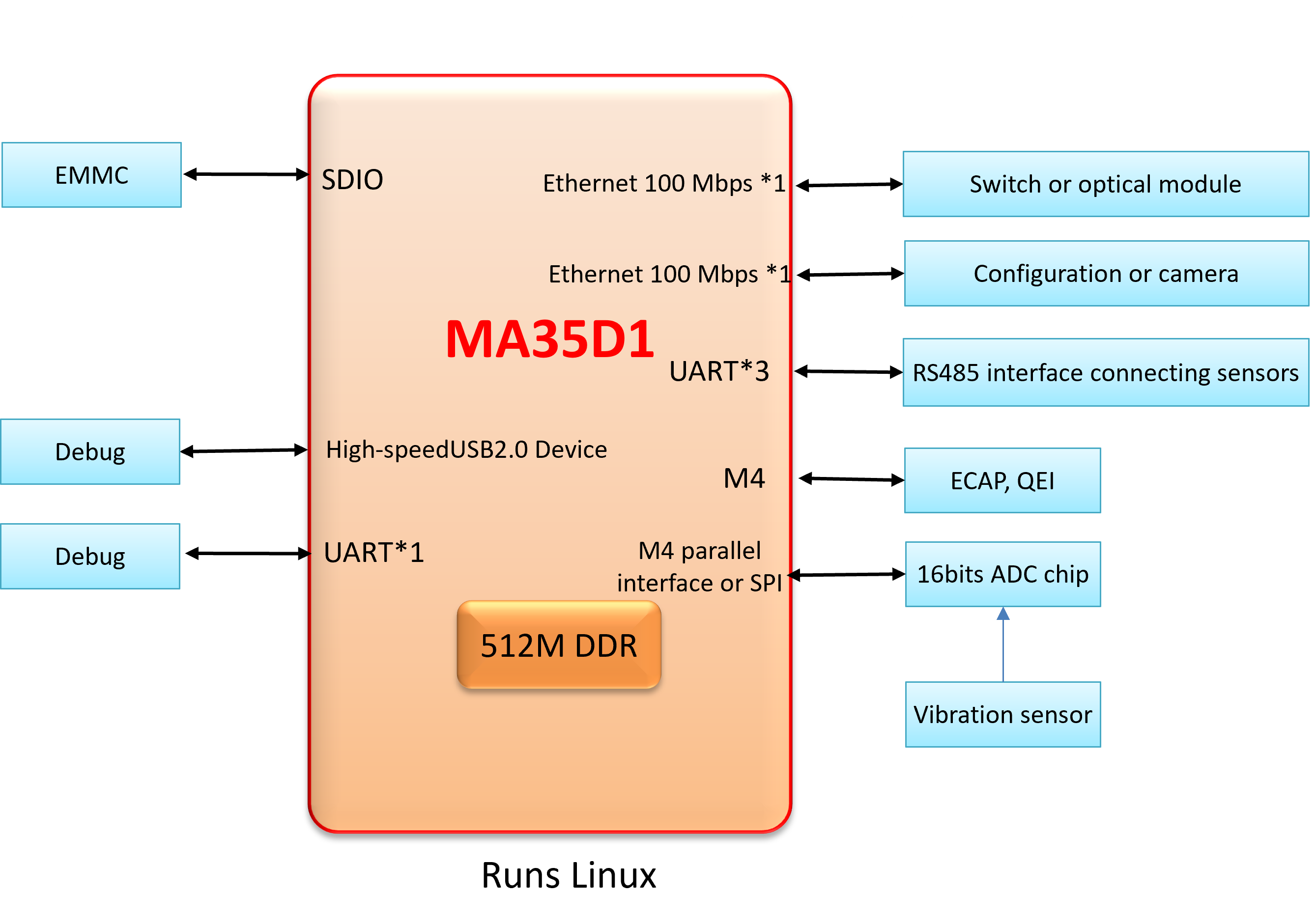
Vibration Monitoring System Diagram
 粤公网安备 44030502010001号